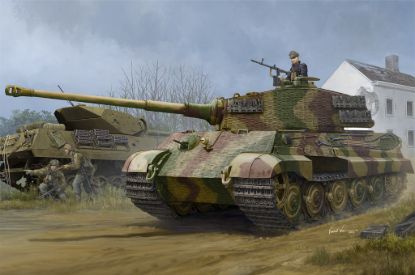
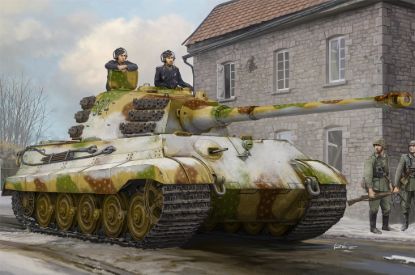
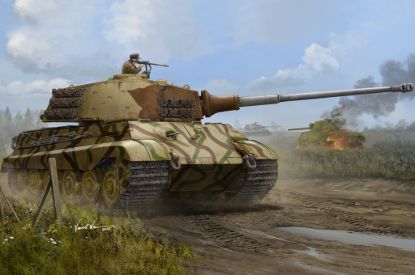
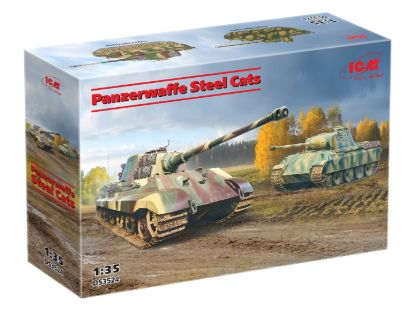
The Tiger II was the successor to the Tiger I, combining the latter's thick armour with the armour sloping used on the Panther medium tank. Contemporaneous Allied soldiers often called it the King Tiger or Royal Tiger. It was the costliest German tank to produce at the time. The tank weighed almost 70 tonnes and was protected by 100 to 185 mm (3.9 to 7.3 in) of armour to the front. It was armed with the long barrelled (71 calibres) 8.8 cm KwK 43 anti-tank cannon. The chassis was also the basis for the Jagdtiger turretless Jagdpanzer anti-tank vehicle.
The Tiger II was the successor to the Tiger I, combining the latter's thick armour with the armour sloping used on the Panther medium tank. Contemporaneous Allied soldiers often called it the King Tiger or Royal Tiger. It was the costliest German tank to produce at the time. The tank weighed almost 70 tonnes and was protected by 100 to 185 mm (3.9 to 7.3 in) of armour to the front. It was armed with the long barrelled (71 calibres) 8.8 cm KwK 43 anti-tank cannon. The chassis was also the basis for the Jagdtiger turretless Jagdpanzer anti-tank vehicle.
The Tiger II was the successor to the Tiger I, combining the latter's thick armour with the armour sloping used on the Panther medium tank. Contemporaneous Allied soldiers often called it the King Tiger or Royal Tiger. It was the costliest German tank to produce at the time. The tank weighed almost 70 tonnes and was protected by 100 to 185 mm (3.9 to 7.3 in) of armour to the front. It was armed with the long barrelled (71 calibres) 8.8 cm KwK 43 anti-tank cannon. The chassis was also the basis for the Jagdtiger turretless Jagdpanzer anti-tank vehicle.
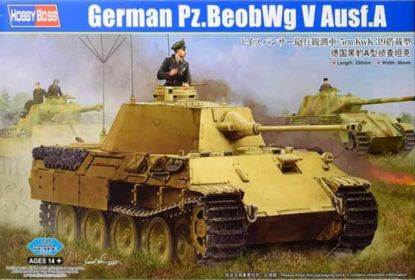
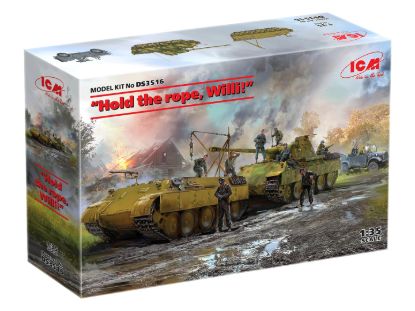
The Pz.BeobWg V Ausf.A, also known as the Panther IV artillery observation tank, was developed as a successor to the Panther IV. It was based on the A-type hull and equipped with a swivel turret and a dummy barrel. By the end of the war, about 40 vehicles had been completed, and some were said to have been deployed in combat.
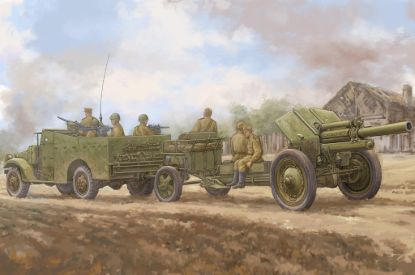
The M3A1 Scout Car, also known as the White Scout Car, was an American armored car produced during World War II. It was used in various roles, including patrol, scouting, command vehicle, ambulance, and gun tractor.
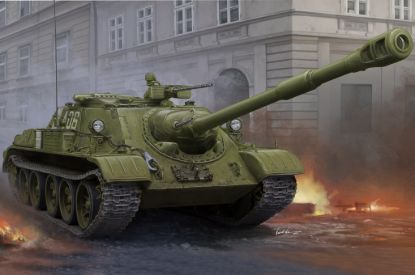
This elusive vehicle was rarely reported on in the West, and for some time its existence and many of the details surrounding it were unknown. Despite the secrecy surrounding it, however, the SU-122-54 was a very real vehicle that saw service, seeing use in some of the largest Soviet military actions of the 1960s. The SU-122-54 was developed, put into production, fielded, and retired, all whilst managing to remain largely a secret from NATO forces.
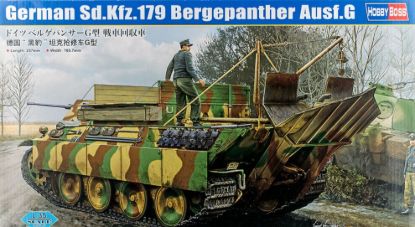
The Bergepanzerwagen V (Sd.Kfz. 179), often referred to as the "Bergepanther", was an armoured recovery vehicle used by the German Army in WWII. It was a variant of the Panzerkampfwagen V Panther (Sd.Kfz. 171).
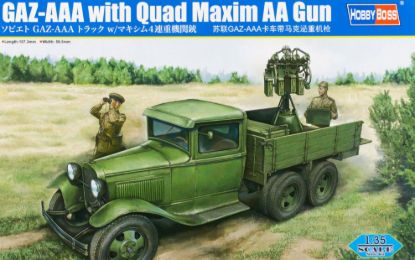
The GAZ-AAA was a significant vehicle in the Soviet military history, serving as a backbone for Red Army transportation during World War II. It was used in various roles, including as a mobile air-defense system, anti-aircraft unit, and even as infantry support.
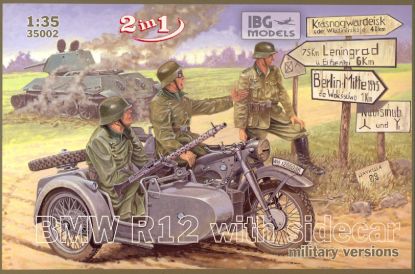
By 1942, the total number of BMW R12 motorcycles manufactured, for military purposes, was 36,000. the single carburetor Einvergaser motor was only available for the R12.
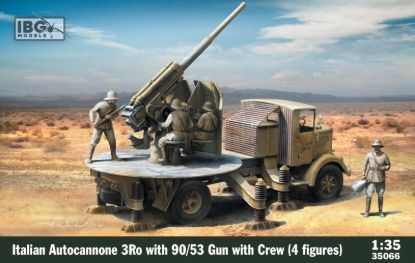
The Lancia Ro, Lancia Ro-Ro and Lancia 3Ro were 4x2 heavy trucks built by Italian manufacturer Lancia from the 1930s through the 1940s for military and civilian use. The 2-cylinder diesel Ro was produced from 1933 to 1939, the 3-cylinder diesel Ro-Ro from 1935 to 1939 and the improved 5-cylinder diesel 3Ro from 1938 to 1947. Ro and 3Ro saw extensive military service during the Second Italo-Ethiopian War and World War II, chiefly as two of the main heavy trucks of the Royal Italian Army.
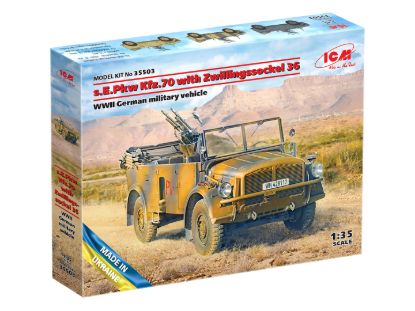
The Krupp Protze (Kfz.70 - Standard configuration for personnel carrying) was a six-wheeled 6×4 German truck and artillery tractor produced between 1934 and 1941 and heavily used in World War II. It was powered by a 4-cylinder, 55 hp or, from 1936, 60 hp Krupp M 304 petrol engine. Its main purpose was to tow artillery, especially the 3.7 cm Pak 36 anti-tank gun (designated Kfz 69), and transport motorized infantry (designated Kfz 70).
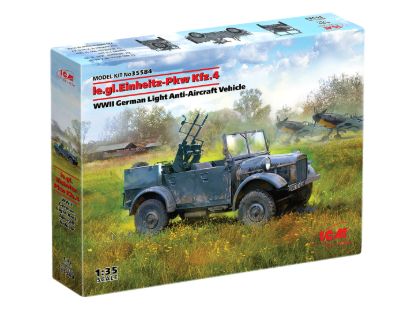
The Kfz 4 Einheits-Pkw were used by repair-and-maintenance squads (Kfz. 2/40), also known as the Einheits-PKW, was a 4x4 light truck used by Germany during World War II.
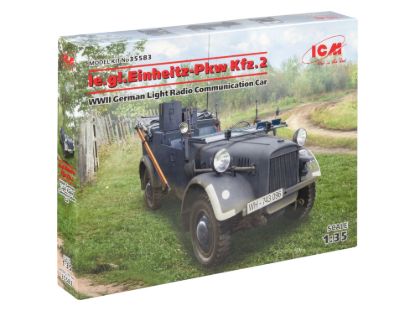
The Kfz 2 Einheits-Pkw were used as troop-level aerial defence (Kfz. 4), also known as the Einheits-PKW, was a 4x4 light truck used by Germany during World War II.
The GAZ AA truck played a crucial role in the Soviet military during the 1930s and World War II. It was the backbone of Soviet civilian and military logistics, serving in both army and national economy.
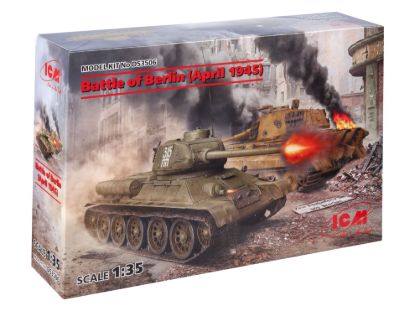
The set includes 225 parts for assembly of T-34-85 Soviet medium tank and 264 parts for assembly of Pz.Kpfw.VI King Tiger (late production) German heavy tank model kits.
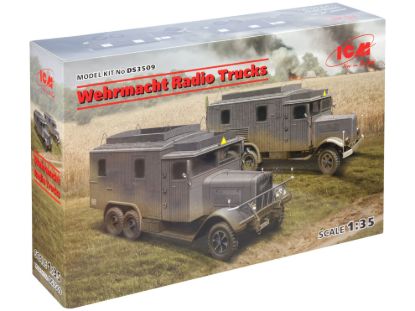
Henschel 33D1 Kfz.72, Krupp L3H163 Kfz.72 Wehrmacht Radio Trucks (radio operation, teletype, telephone operation, radio listening, weather and printing car)
The set includes 319 parts for assembly of Henschel 33D1 Kfz.72 and 306 parts for assembly of Krupp L3H163 Kfz.72 WWII German radio trucks model kits.
The Diorama set includes a Pz,Kpfw. V Ausf. D (Panther), a Bergepanther recovery vehicle and a Kfz.4 with AA-guns along with German tank crew and drivers.