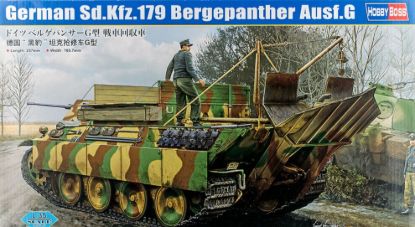
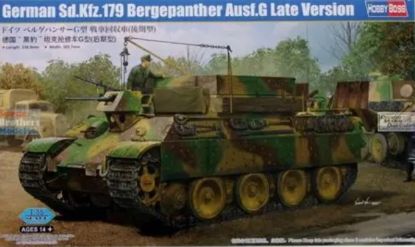
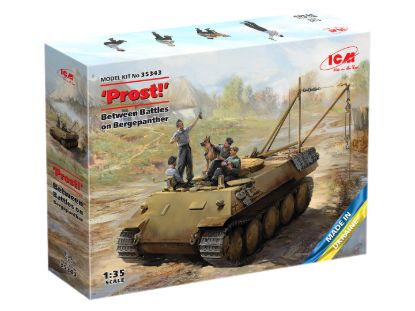
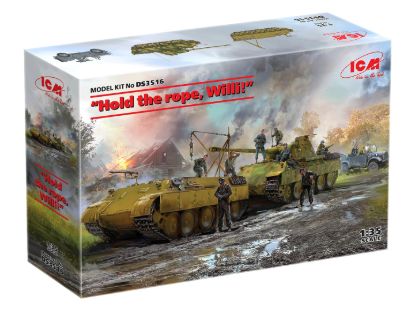
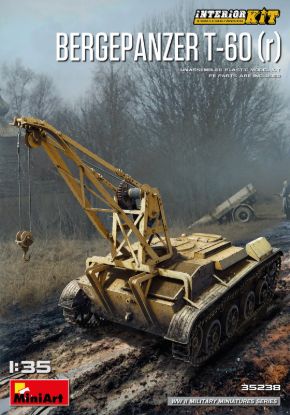
The Bergepanzerwagen V (Sd.Kfz. 179), often referred to as the "Bergepanther", was an armoured recovery vehicle used by the German Army in WWII. It was a variant of the Panzerkampfwagen V Panther (Sd.Kfz. 171).
The Bergepanzerwagen V (Sd.Kfz. 179), often referred to as the "Bergepanther", was an armoured recovery vehicle used by the German Army in WWII. It was a variant of the Panzerkampfwagen V Panther (Sd.Kfz. 171).
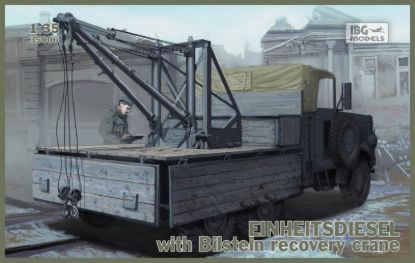
The Einheitsdiesel trucks were a significant part of the military history of the Wehrmacht during World War II. They were developed to standardize the military's vehicle fleet, which had previously consisted of a disparate collection of often-modified civilian models.
The Diorama set includes a Pz,Kpfw. V Ausf. D (Panther), a Bergepanther recovery vehicle and a Kfz.4 with AA-guns along with German tank crew and drivers.
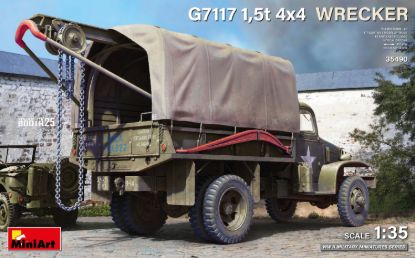
The Chevrolet G7100, also known as the G506, was a significant part of the United States Army's logistics during World War II. These trucks were produced in large numbers by Chevrolet and became standard 1-ton 4x4 trucks for the US Army and Army Air Corps.
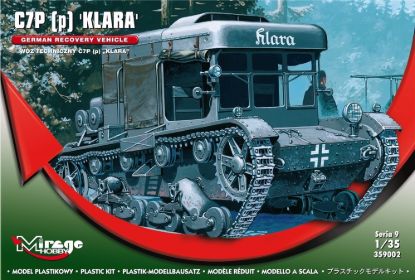
The German capture version of a C7P artillery tractor. The tactor was a significant development in the Polish military's artillery capabilities before and during World War II.
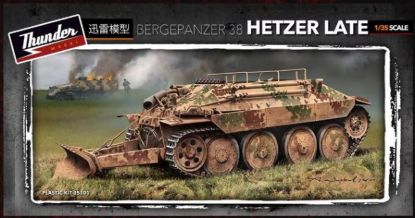
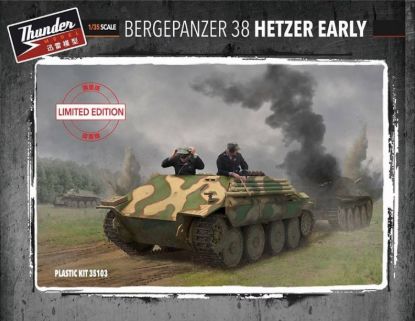
The light recovery vehicle Bergepanzer 38 or Bergepanzerwagen 38 was based on the German Jagdpanzer 38, the Hetzer tank destroyer. This light recovery vehicle, German designation Sd.Kfz. 136, was used with the Jagdpanzer units and helped repair the tank destroyers, it was capable of towing or pulling the Hetzer tanks if broken down or stuck. Between 170 to 181 were built from August 1944 until the end of the war. It used a Fug 5 radio set and was armed with a MG 34.
The light recovery vehicle Bergepanzer 38 or Bergepanzerwagen 38 was based on the German Jagdpanzer 38, the Hetzer tank destroyer. This light recovery vehicle, German designation Sd.Kfz. 136, was used with the Jagdpanzer units and helped repair the tank destroyers, it was capable of towing or pulling the Hetzer tanks if broken down or stuck. Between 170 to 181 were built from August 1944 until the end of the war. It used a Fug 5 radio set and was armed with a MG 34.
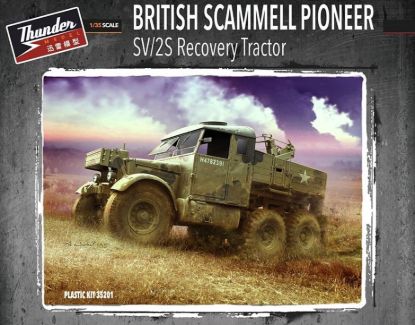
The Scammell Pioneer SV/2S Recovery Tractor played a significant role in the military history of the British Army during World War II. Initially designed as an artillery tractor, it evolved into a versatile recovery vehicle and tank transporter. The tractor's design allowed it to tow heavy artillery pieces and recover equipment, making it an essential tool for the British forces. Despite its initial use as an artillery tractor, the Pioneer SV/2S was also utilized as a recovery vehicle, with a simplified crane for greater lifting height. The tractor's tracks could be fitted over the rear wheels, converting it into a half-track for improved traction on soft ground. The Pioneer SV/2S was a testament to Scammell's innovative spirit and its ability to adapt to the evolving needs of military operations.
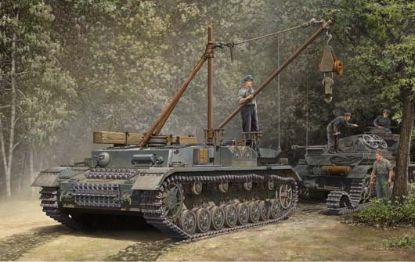
The Bergepanzer IV was a German armoured recovery vehicle developed in the 1940s based on the late Panzer IV chassis. It was designed to recover damaged tanks and was based on the Panzer IV chassis.