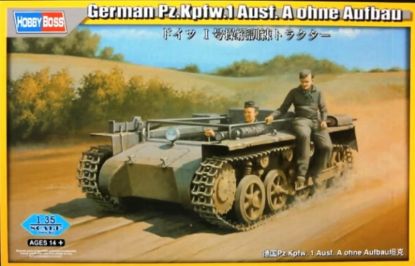
The Sd.Kfz.111, also known as the gepanzerte Munitionsschlepper, was a military vehicle used by Nazi Germany during World War II. It was primarily based on the chassis of the Panzerkampfwagen I M.G. Sd. Kfz. 101 Ausf. A and was designed to transport ammunition. The vehicle was created by removing the turret and adding a simple open-topped box body. It was intended for units equipped with the 7.62 cm Pak 36 (r) ammunition. The Sd.Kfz.111 was converted from 50 vehicles, with additional contracts for conversion reported by DEW, leading to a total of 122 vehicles converted by the end of the war.
The Sd.Kfz.111, also known as the gepanzerte Munitionsschlepper, was a military vehicle used by Nazi Germany during World War II. It was primarily based on the chassis of the Panzerkampfwagen I M.G. Sd. Kfz. 101 Ausf. A and was designed to transport ammunition. The vehicle was created by removing the turret and adding a simple open-topped box body. It was intended for units equipped with the 7.62 cm Pak 36 (r) ammunition. The Sd.Kfz.111 was converted from 50 vehicles, with additional contracts for conversion reported by DEW, leading to a total of 122 vehicles converted by the end of the war.
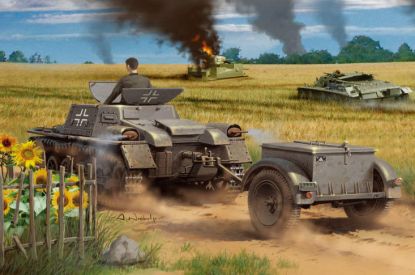
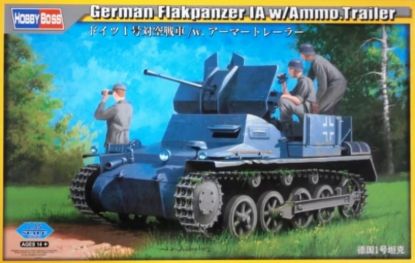
The Panzer I saw combat in the Spanish Civil War and WWII. The Panzer I's design history can be traced to the British Carden Loyd tankette, of which it borrowed much of its track and suspension design.
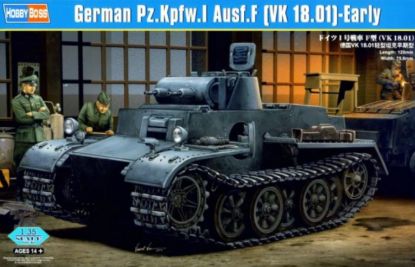
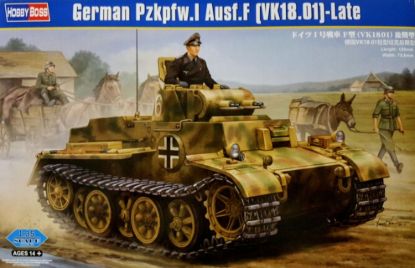
The Panzer I Ausf. F, was as different from the Ausf. C as it was from the Ausf. A and B.[28] Intended as an infantry support tank, the Panzer I Ausf. F had a maximum armor thickness of 80 millimeters (3.15 in) and weighed between 18 and 21 tonnes.[29] The Ausf. F was armed with two 7.92 mm MG-34s.[30] Thirty were produced in 1940, and a second order of 100 was later canceled. In order to compensate for the increased weight, a new 150 horsepower (110 kW) Maybach HL45 Otto engine was used, allowing a maximum road speed of 25 kilometers per hour (15.5 mph) and used five overlapping road wheels per side, dropping the Ausf. C's interleaved units.
The Panzer I Ausf. F, was as different from the Ausf. C as it was from the Ausf. A and B.[28] Intended as an infantry support tank, the Panzer I Ausf. F had a maximum armor thickness of 80 millimeters (3.15 in) and weighed between 18 and 21 tonnes.[29] The Ausf. F was armed with two 7.92 mm MG-34s.[30] Thirty were produced in 1940, and a second order of 100 was later canceled. In order to compensate for the increased weight, a new 150 horsepower (110 kW) Maybach HL45 Otto engine was used, allowing a maximum road speed of 25 kilometers per hour (15.5 mph) and used five overlapping road wheels per side, dropping the Ausf. C's interleaved units.