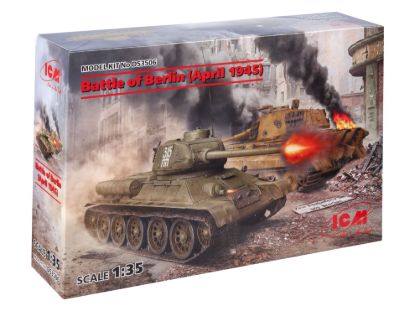
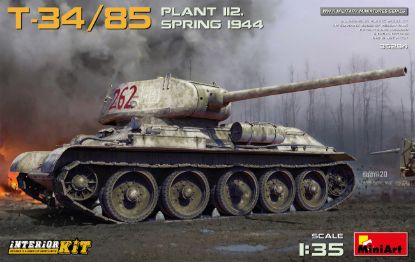
The set includes 225 parts for assembly of T-34-85 Soviet medium tank and 264 parts for assembly of Pz.Kpfw.VI King Tiger (late production) German heavy tank model kits.
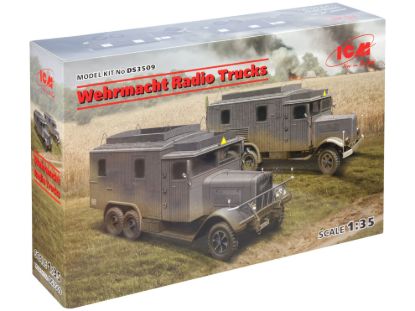
Henschel 33D1 Kfz.72, Krupp L3H163 Kfz.72 Wehrmacht Radio Trucks (radio operation, teletype, telephone operation, radio listening, weather and printing car)
The set includes 319 parts for assembly of Henschel 33D1 Kfz.72 and 306 parts for assembly of Krupp L3H163 Kfz.72 WWII German radio trucks model kits.
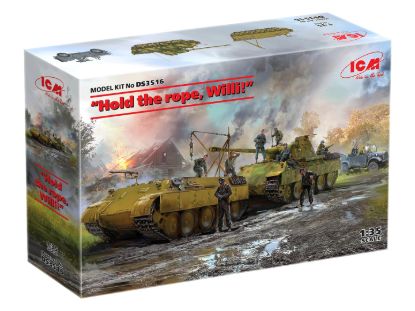
The Diorama set includes a Pz,Kpfw. V Ausf. D (Panther), a Bergepanther recovery vehicle and a Kfz.4 with AA-guns along with German tank crew and drivers.
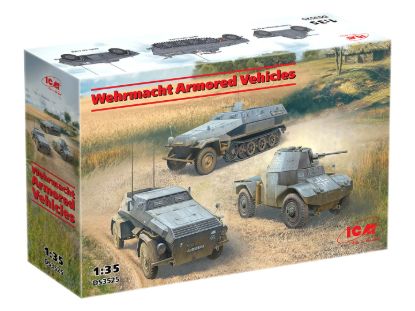
The Sd.Kfz. 251/1, also known as the mittlere Schützenpanzerwagen (IR) Falke, was the standard German personnel carrier and a significant vehicle in the military history of World War II. It was designed to transport a squad of Panzergrenadiers to the battlefield, providing protection from small arms fire and artillery shrapnel. The vehicle was armed with two MG34 or MG42 machine guns for defense and direct support. The Sd.Kfz. 251/1 was used extensively by Nazi Germany during the war, particularly on the Eastern front, and later in the Western front.
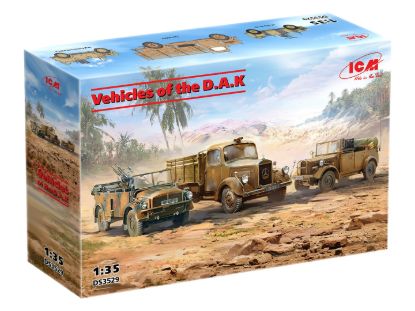
Vehicles of the D.A.K includes the Mercedes-Benz L3000S, The Krupp Protze (Kfz.70) Anti-Aircraft Vehicle, and the Einheits-Pkw ( Kfz.2) Radio Communication Car. These vehicles were used by Germany in every theater of service during World War II.
The GAZ AA truck played a crucial role in the Soviet military during the 1930s and World War II. It was the backbone of Soviet civilian and military logistics, serving in both army and national economy.
The GAZ-AAA was a significant vehicle in the Soviet military history, serving as a backbone for Red Army transportation during World War II. It was used in various roles, including as a mobile air-defense system, anti-aircraft unit, and even as infantry support.
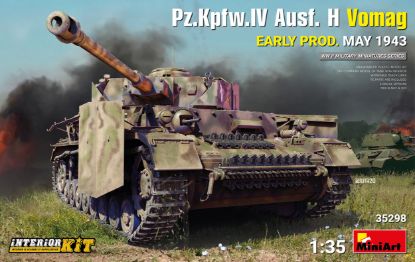
The Sd.Kfz. 161, also known as the Panzer IV, was a medium tank developed in Nazi Germany in the late 1930s and used extensively during World War II as well as later wars. It was the most numerous German tank and the second-most numerous German fully tracked armored fighting vehicle of the war, with 8,553 units produced. The Panzer IV was initially designed for infantry support but evolved to become the primary tank for German forces due to its ability to engage enemy armor effectively. It was the only German tank to remain in continuous production throughout the war, with over 8,800 units produced between 1936 and 1945.
The Panzer IV was originally intended to be used only on a limited scale, so initially Krupp was its sole manufacturer. Prior to the Polish campaign, only 217 Panzer IVs had been produced: 35 Ausf. A; 42 Ausf. B; and 140 Ausf. C; in 1941, production was extended to Vogtländische Maschinenfabrik ("VOMAG") (located in the city of Plauen) and the Nibelungenwerk in the Austrian city of St. Valentin.
The GAZ AA truck played a crucial role in the Soviet military during the 1930s and World War II. It was the backbone of Soviet civilian and military logistics, serving in both army and national economy.