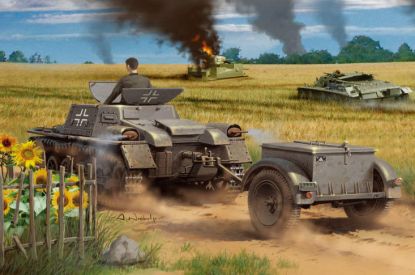
The Sd.Kfz.111, also known as the gepanzerte Munitionsschlepper, was a military vehicle used by Nazi Germany during World War II. It was primarily based on the chassis of the Panzerkampfwagen I M.G. Sd. Kfz. 101 Ausf. A and was designed to transport ammunition. The vehicle was created by removing the turret and adding a simple open-topped box body. It was intended for units equipped with the 7.62 cm Pak 36 (r) ammunition. The Sd.Kfz.111 was converted from 50 vehicles, with additional contracts for conversion reported by DEW, leading to a total of 122 vehicles converted by the end of the war.
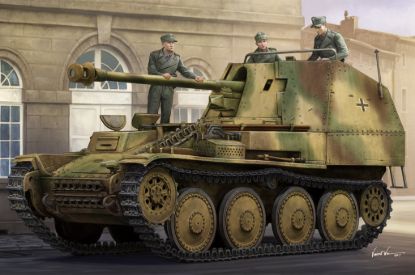
The Marder III, specifically, was equipped with the German 7.5 cm PaK 40 anti-tank gun, which was highly effective in penetrating the armor of most Allied tanks at standard engagement ranges. The Marder III served on all fronts until the end of the war, providing significant firepower to counter the thick-armored T-34s.
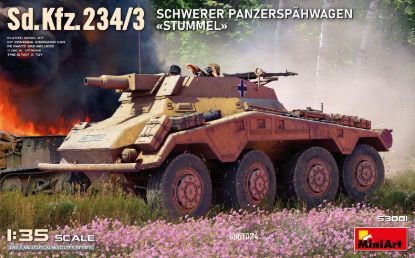
The SdKfz 234 Puma was a German eight-wheeled heavy armored car developed during World War II. After it was clear that a stronger armament was necessary to fight the Soviet tank units, the SdKfz 234/3 with a short 7.5 cm gun and then the SdKfz 234/4 with a long 7.5 cm Pak 40, which were rigidly mounted to the front in an open top stand, appeared. The Puma was primarily designed for reconnaissance missions, but its firepower (especially in the 234/2 variant) made it capable of engaging enemy light armor. Its excellent mobility and range allowed it to operate effectively behind enemy lines. The SdKfz 234 series represented the pinnacle of German armored car design during WWII, combining mobility, firepower, and reasonable protection. The diesel engine provided superior range compared to most contemporary vehicles.